
When I arrived in Papua New Guinea in 1995, I noticed that the fallow vegetation in many shifting cultivation systems was dominated by a single species. Foresters told me it was Piper aduncum, an introduced species. At that time no systematic research was done on the cause for its spreading nor on its effects on soils and crops. That were reasons for a series of investigations and experiments. Below is a brief report on this highly important plant invader including current research activities and some future plans.
- Bioinvasion
- Origin of Piper aduncum
- Spreading of Piper aduncum
- Our research
- Current research
- Contact
- Publications
Bioinvasion
Introducing plant species into new environments can have many unanticipated ecological effects. Whether deliberately introduced as ornamentals and economic plants or brought in accidentally, new species can have devastating effects on ecosystem quality and functioning through out-competing indigenous species and habitat modification. As a result, an endemic flora may become extinct. An example which has recently gained attention in Africa and Asia is the small shrub Chromolaena odorata, a native of Central and South America which was brought to Asia in the late 19th century. It then spread rapidly across Asia and arrived in Africa in the 1940s. Its spread is closely related to human activities, in particular frequent disturbances of the natural vegetation from agriculture and road maintenance. An example from the Pacific is Miconia calvescens which was introduced as an ornamental but is now one of the major pests in the Society Islands of the Pacific where it is nicknamed the “green cancer”.
In many areas of Papua New Guinea the shrub Piper aduncum has invaded. The invasion of Piper aduncum in the humid lowlands appears similar to the spreading of Chromolaena odorata in Asia and parts of West Africa, and to the invasion of Miconia calvescens.
 Origin of Piper aduncum
Piper aduncum is a member of the family Piperaceae of which there are some economically important species in the Pacific, including Piper nigrum (pepper), Piper methysticum (kava), and Piper bettle of which the fruits are used with betel nut (Areca cathecu) in Papua New Guinea. Piper aduncum is a shrub or small tree with alternate leaves and spiky flowers and fruits. It occasionally reaches an height of 7 to 8 m, and has very small seeds, which are mostly dispersed by the wind, fruit bats and birds. Piper aduncum is common throughout Central America where it is found between sea level and 2,000 m a.s.l. along roadsides and in forest clearance areas on well-drained soils. It occurs in Mexico, Central America, Surinam, Cuba, Southern Florida, Trinidad and Tobago, and Jamaica and is very common in Costa Rica on open or partly shaded sites. In the Neotropics, Piper aduncum may be locally abundant but the species rarely dominates the vegetation or is found in mature vegetation. In the Amazon areas, it has been reported as an invading plant after timber exploitation. Extracts of Piper aduncum are used as folk medicine in South America. The species is mentioned in several ethnopharmalogical databases, and has antifungal and antibacterial compounds.


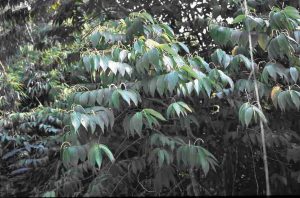
Thumbnails: In Malaysia Piper aduncum is common in secondary
fallow vegetation in the Genteng Highlands
Spreading of Piper aduncum
Piper aduncum was introduced in the Botanical gardens of Bogor (Indonesia) in the 1860. By the 1920s, it commonly occurred in a radius of 50 to 100 km around the Botanical Gardens in young secondary vegetation, close to rivers and on very steep slopes, locally in dense stands. Piper aduncum was noted in Jayapura in 1955 and in Biak in 1960 on Papua (Irian Jaya) and in Malaysia (see thumbnails above) and Borneo in the 1960s. It has also been recorded in Singapore and Sumatra, and is on the list of unwanted weed species by the quarantine service of Australia. Piper aduncum was introduced into Fiji in the 1920s and is now widespread in the wet and intermediate zones of Viti Levu. It is also found on Hawaii, Vanuatu, Christmas Island and the Solomons Islands. It is not known when and how Piper aduncum arrived in Papua New Guinea but it is likely that the seeds came in by accidental transport from Papua or perhaps from Fiji. The botanist Mary Clemens first observed Piper aduncum in 1935 near the mission station Heldsbach in the Morobe Province.
It was not very widespread in the early 1970s and Piper aduncum is not separately listed in the standard text on New Guinea vegetation by Paijmans. By the late 1990s Piper aduncum is very common in the lowlands of the Morobe and Madang Provinces, and is also observed in the Central Highlands above 2,000 m a.s.l. Seeds are being spread by flying foxes and logging equipment. Causes for its rapid spreading remain unclear but evidence is being accumulated that areas of high native plant species richness and cover, like many areas in Papua New Guinea, and areas high in soil fertility may be highly invasible.


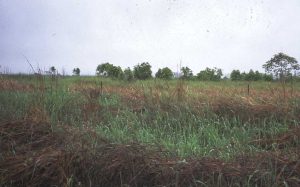
Thumbnails (left to right): In Papua new Guinea Piper aduncum is common in
secondary fallow vegetation; along road cuts; in the highlands near Mt Hagen;
it can nowadays also been seen invading imperata grasslands (Markham valley)
Our research
Despite the widespread occurrence of Piper aduncum fallows in the humid lowlands of Papua New Guinea, there is no information available on the amount of biomass and nutrients. There is also no information available on the effects of Piper aduncum on the subsequent crop. Therefore, I started a series of experiments in 1996 that investigated these effects. The experiments were conducted in Hobu, near Lae, Papua New Guinea.
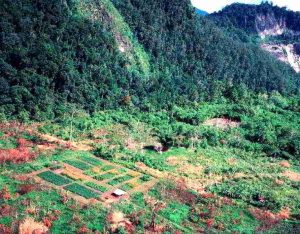


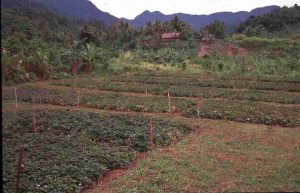
Thumbnails (left to right): The experimental site at Hobu; one-year old Piper aduncum trees; fallow experiment with gliricidia, piper and imperata; installation of litterbags in
previous Piper aduncum plots; plots planted with sweet potato
In the first experiment we planted Piper aduncum plots and also plots with Gliricidia sepium and Imperata cylindrica (see thumbnails). The fallows were slashed after one year and sweet potato was planted. The effects of the fallows on sweet potato yield were investigated including nutrient dynamics, decomposition of the fallow biomass, nutrient uptake and soil chemical and physical changes. In another experiment the nutrient and biomass accumulation of Piper aduncum were followed for two years. Our results have shown that Piper aduncum accumulates large amounts of biomass and nutrients, particularly K, and that is has significant effects on the soil and its productivity, further details are here.


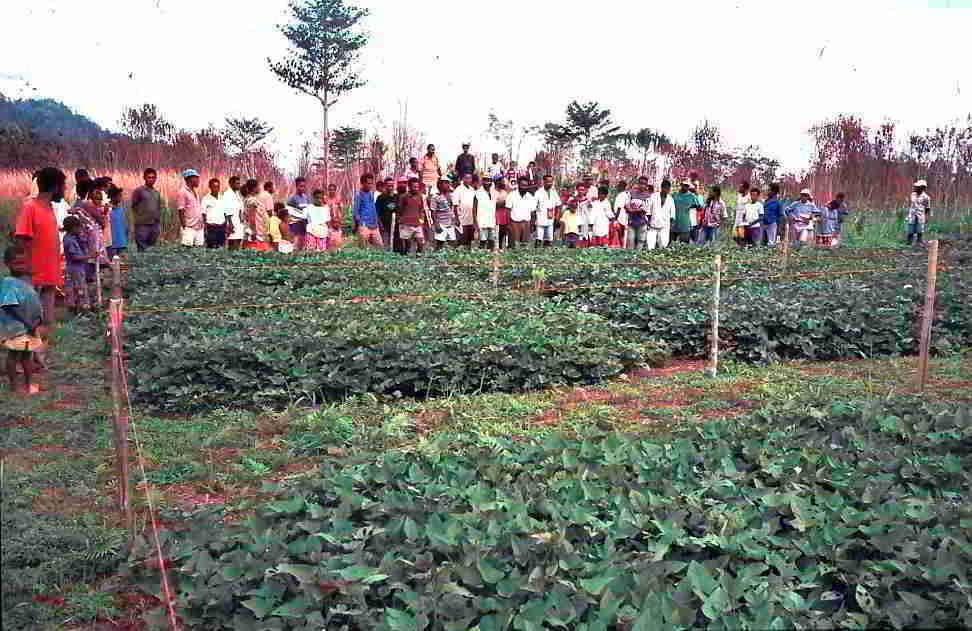
Thumbnails (left to right): Piper aduncum garden Hobu; experimental site in 1998;
Piper aduncum roots (shallow); farmers’ open day at experimental site in Hobu
Current Research (2003-2007)
Our research focused on the soil and crop effects as well collecting some basic growth data on Piper aduncum. During the research we talked to many farmers and it became obvious that different farmers had different perceptions. Some liked and used its wood and leaves for various purposes whereas others felt it was unwanted fallow species. A comment often heard was that “em mekim graun drai” (it dries the soil) – a finding which we proved in various experiments. No systematic investigation was undertaken on the socio-economics effects of Piper aduncum.
Thomas Siges, a MSc student from Wageningen University conducted fieldwork near Finschhafen (Saruwaged mountain range) from July to November 2003. He investigated the effects on the livelihoods of farmers in three different villages where Piper aduncum is common. Thomas interviewed a large number of farmers and asked them how they perceive the invasion of Piper aduncum, how they used its products and whether it has changed their farming systems. The table below shows the significance of plant uses in three study villages.
X: Less frequently used. XX: Frequently used. XXX: More frequently used. (-): Not used.
From Siges, Hartemink, Hebinck and Allen (2005)
| Sanangac | Sanzeng | Tongucboc | |
| Farm uses | |||
| Digging stick | XXX | X | – |
| making fences | XXX | XXX | XX |
| Stakes | XXX | XXX | XX |
| Pegs | XX | X | – |
| Tool handles | XX | XX | X |
| Soil retention structures | XXX | XXX | XXX |
| Shade | XX | XXX | X |
| Helps tillage | XXX | XXX | XX |
| Good fertilizer | XXX | XX | X |
| Burn debris | XXX | XXX | XXX |
| Weed control
|
XXX | X | X |
Household uses |
|||
| Cleaning stains on cooking utensils | XXX | XXX | XXX |
| Temporary platforms for resting | X | X | X |
| Ashes used as insecticide | X | X | XX |
| Leaves used as toilet tissues | XXX | XXX | X |
| Walking stick | X | X | X |
| Fire stick | XXX | XXX | XXX |
| Fuel wood | XXX | XXX | XXX |
| Rafters for houses | XXX | XXX | X |
| Poles for buildings | XX | X | – |
| Cleaning stains on teeth | XX | X | XX |
| Plant support | XXX | XXX | XX |
| Sticks for flower bed fences | X | X | X |
| Making temporary ladders
|
XX | X | – |
| Services | |||
| Attracts wild animals | XX | XXX | XX |
| Improves soil fertility | X | XX | X |
| Dries of waterlogged soils | X | X | X |
| Provides shades | XX | XXX | X |
| Chases away the leech | X | XX | X |
| Host to other useful plants | – | X | – |
| Good sweet potato yield in short fallow | XXX | XX | XX |
| Provides wind breaks | XX | XX | XX |
The table shows that piper is widely used. The invasion and dominance of piper has also some negative effects on rural livelihoods in the study area. This is mainly related to the destruction of the natural forest that is being replaced by secondary fallow vegetation dominated by piper, and in part it is due to the loss of natural secondary fallows vegetation. There is loss of social cohesion due the enhanced clearing of the forest, vanishing sacred places, disapperance of certain forest products and the destruction of the natural forest.
Currently, we are working on a project proposal that aims to to map the current status of Piper aduncum invasion in PNG using remote sensing techniques.
Contact
I welcome all comments on this information and please send it to my contact address. I would be particularly interested to hear what your experiences are with this species and whether this species is a problem in your part of the world and how it is used.